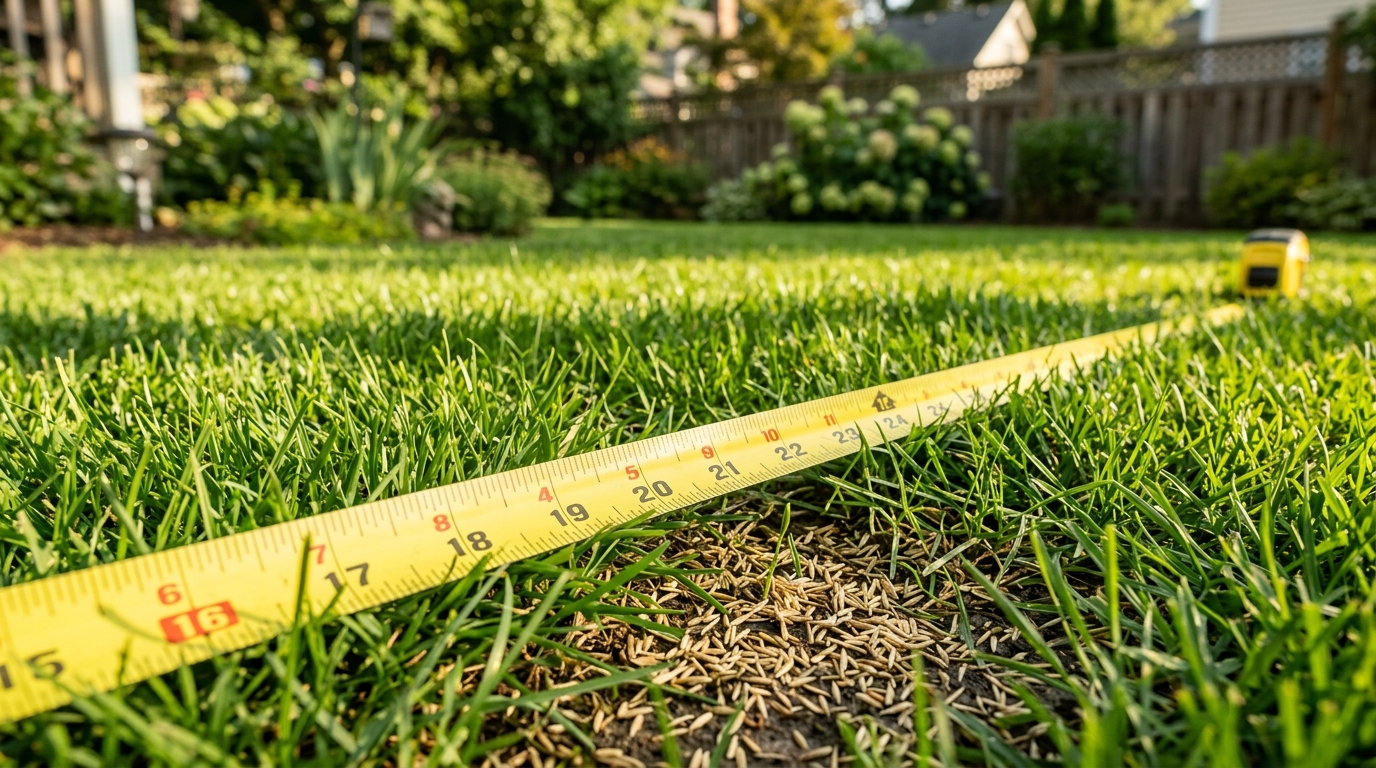
Grass seed bags list coverage rates “per 1,000 sq ft” because that’s the lawn-care industry standard. But your lawn probably isn’t exactly 1,000 square feet. This guide bridges the gap — showing you how to convert bag rates to your actual lawn size, whether it’s 500 sq ft or 10,000 sq ft.
Enter your lawn dimensions in feet and get instant seed estimates.
Open CalculatorQuick Reference Table
This table shows how many pounds of grass seed you need for common US residential lawn sizes. Rates are for new lawn seeding (full rate). For overseeding, use half these amounts.
| Lawn Size (sq ft) | Kentucky Bluegrass | Tall Fescue | Perennial Ryegrass | Bermuda Grass | Fine Fescue |
|---|---|---|---|---|---|
| 500 | 1.75 lbs | 4.5 lbs | 3.75 lbs | 1.75 lbs | 2.5 lbs |
| 1,000 | 3.5 lbs | 9 lbs | 7.5 lbs | 3.5 lbs | 5 lbs |
| 2,500 | 8.75 lbs | 22.5 lbs | 18.75 lbs | 8.75 lbs | 12.5 lbs |
| 5,000 | 17.5 lbs | 45 lbs | 37.5 lbs | 17.5 lbs | 25 lbs |
| 10,000 | 35 lbs | 90 lbs | 75 lbs | 35 lbs | 50 lbs |
Major brands (Scotts, Pennington, Jonathan Green) print rates as “X lbs per 1,000 sq ft.” To find your amount: divide your lawn area by 1,000, then multiply by the bag rate. Example: 7,500 sq ft lawn × 9 lbs / 1,000 = 67.5 lbs of Tall Fescue.
How to Measure Your Lawn in Square Feet
Accurate measurement is the foundation of a good seed estimate. Here are three methods from simplest to most precise:
- Tape measure (rectangle method): Walk the length and width of your lawn in feet. Multiply length × width. For a 50 ft × 80 ft yard: 50 × 80 = 4,000 sq ft.
- Measuring wheel: Roll a measuring wheel along each edge. Great for curved or irregular borders. Available at hardware stores for under $30.
- Google Maps satellite view: Use the “Measure distance” tool to outline your lawn. Free, reasonably accurate, and you never leave your desk.
For irregular lawns, break the area into rectangles, triangles, or circles. Calculate each section and add them together. Our grass seed calculator supports all four shapes with per-field unit selectors.
Per Square Foot vs. Per 1,000 Sq Ft — What’s the Difference?
They’re the same rate expressed differently. The industry uses “per 1,000 sq ft” because the per-square-foot numbers are tiny and impractical:
| Grass Type | Per 1,000 sq ft (lbs) | Per sq ft (lbs) | Per sq ft (oz) |
|---|---|---|---|
| Kentucky Bluegrass | 3.5 | 0.0035 | 0.056 |
| Tall Fescue | 9 | 0.009 | 0.144 |
| Perennial Ryegrass | 7.5 | 0.0075 | 0.12 |
| Bermuda Grass | 3.5 | 0.0035 | 0.056 |
As you can see, working in ounces-per-square-foot is cumbersome. Always use the per 1,000 sq ft rate and scale it to your total area.
Adjusting for Grass Type
Seed size drives the rate difference. Small seeds like Kentucky Bluegrass contain roughly 2.2 million seeds per pound, so you need fewer pounds to achieve dense coverage. Large seeds like Tall Fescue have around 227,000 seeds per pound, requiring more weight for the same density.
Frequently Asked Questions
How many sq ft does a 50 lb bag cover?
It depends on the grass type. A 50 lb bag of Tall Fescue (at 9 lbs/1,000 sq ft) covers about 5,555 sq ft for a new lawn. A 50 lb bag of Kentucky Bluegrass (at 3.5 lbs/1,000 sq ft) covers about 14,285 sq ft. For detailed bag-size breakdowns, see our 50 lb bag coverage guide.
How do I calculate seed for a 7,500 sq ft lawn?
Divide 7,500 by 1,000 = 7.5 units. Multiply by your grass type’s rate. For Tall Fescue: 7.5 × 9 = 67.5 lbs. For Kentucky Bluegrass: 7.5 × 3.5 = 26.25 lbs. Or just enter 7,500 sq ft in our calculator and get instant results.
My lawn is bigger than 10,000 sq ft — should I calculate by acre instead?
For lawns over ¼ acre (10,890 sq ft), calculating by acre is more practical and aligns with bulk seed pricing. See our per acre calculator guide for pasture and large-property seeding rates.