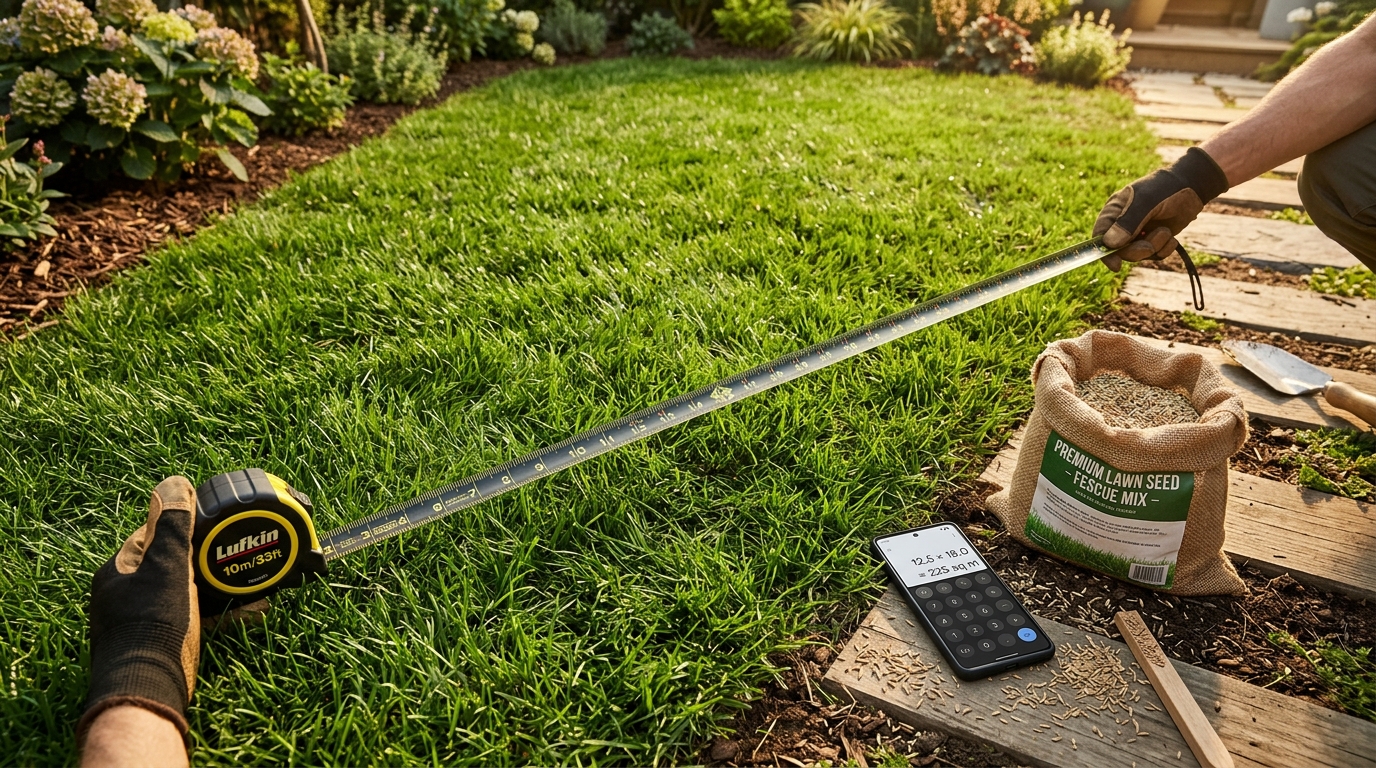
The amount of grass seed you need depends on three factors: your lawn’s total area, the grass species you’re planting, and whether you’re starting a new lawn or overseeding an existing one. A typical residential lawn of 5,000 sq ft (464 m²) needs anywhere from 10 lbs to 50 lbs of seed depending on the variety. The calculator below gives you the exact number in seconds — no math required.
Enter your lawn dimensions, grass type, and project type to get precise seed estimates in pounds and kilograms.
Open Grass Seed CalculatorHow the Calculator Works
Our free grass seed calculator uses a simple but precise formula to estimate exactly how much seed you need:
Seed (lbs) = Coverage Rate (lbs / 1,000 ft²) × Lawn Area (ft²) ÷ 1,000
Here’s what you enter:
- Lawn size: Enter width and length (or radius for circles). The calculator supports rectangles, circles, ellipses, and triangles. You can mix units — feet, meters, yards, or even miles for large properties.
- Grass species: Choose from 10 types including Kentucky Bluegrass, Tall Fescue, Bermuda Grass, Perennial Ryegrass, Fine Fescue, Zoysia, Centipede, Bahia, Buffalo, and St. Augustine. Each has a different seeding rate pre-loaded.
- Project type: New lawn (full rate), overseeding (50% rate), or patch repair (75% rate).
The output shows your total seed in both pounds and kilograms, estimated bag count, total lawn area in sq ft and m², and optional cost estimation. A buffer slider (0–30%, default 10%) accounts for seed lost to wind, birds, and uneven spreading.
General Seeding Rate Guidelines
Seeding rates vary widely by grass type. Cool-season grasses (planted in fall) generally need more seed per area than warm-season grasses (planted in late spring). Here’s a comprehensive reference table:
| Grass Type | Season | New Lawn (lbs/1,000 ft²) | New Lawn (g/m²) | Overseed (lbs/1,000 ft²) | Germination (days) |
|---|---|---|---|---|---|
| Kentucky Bluegrass | Cool | 2–5 | 10–24 | 1–2.5 | 14–30 |
| Tall Fescue | Cool | 8–10 | 39–49 | 4–5 | 7–14 |
| Fine Fescue | Cool | 4–6 | 20–29 | 2–3 | 7–14 |
| Perennial Ryegrass | Cool | 7–8 | 34–39 | 3.5–4 | 5–10 |
| Bermuda Grass | Warm | 3–4 | 15–20 | 1.5–2 | 10–30 |
| Zoysia Grass | Warm | 1–3 | 5–15 | 0.5–1.5 | 14–21 |
| Centipede Grass | Warm | 1–2 | 5–10 | 0.5–1 | 14–28 |
| Bahia Grass | Warm | 7–10 | 34–49 | 3.5–5 | 14–28 |
| Buffalo Grass | Warm | 3–5 | 15–24 | 1.5–2.5 | 14–30 |
St. Augustine Grass is not available as seed — it must be established from sod or plugs. If you need St. Augustine, skip the calculator and order sod by the pallet (a standard pallet covers ~450 sq ft).
New Lawn vs. Overseeding Rates
Overseeding uses roughly half the seed rate of a new lawn. Why? When you overseed, existing turf already occupies much of the ground. Adding too much seed creates excessive competition, leading to thin, weak grass.
For a complete walkthrough of overseeding rates, timing, and step-by-step instructions, read our dedicated Grass Seed Calculator for Overseeding guide.
Small Lawn vs. Large Property
The calculator works for any size, but the buying strategy changes with scale:
For square foot measurements, see our Grass Seed Calculator Per Square Foot guide. For metric users, check the Grass Seed Calculator Per m² page. For large rural properties, our Grass Seed Calculator Per Acre guide covers bulk buying, spreader settings, and pasture grasses.
What to Do After Spreading Seed
Spreading seed is only half the job. Protecting your seed after application is critical for germination success:
- Cover the seed lightly with straw, peat moss, or a thin layer of topsoil. This retains moisture, prevents bird predation, and shields seed from wind. A light straw covering at 1–2 bales per 1,000 sq ft is the most common method. See our full guide: How Much Straw or Peat Moss to Cover Grass Seed.
- Water immediately and frequently. Keep the top ½ inch of soil moist with light, frequent watering (2–3 times daily for 5–10 minutes) until seedlings emerge.
- Avoid foot traffic for 4–6 weeks. Newly germinated grass is fragile and can’t handle walking, mowing, or pet activity.
- Apply starter fertilizer at seeding time. Use a phosphorus-rich formula (e.g., 10-18-10) to encourage root development.
- First mow at 3–4 inches. Wait until new grass reaches this height, then mow no more than ⅓ of the blade. Use a sharp mower blade to prevent tearing seedlings.
Frequently Asked Questions
Can I use too much grass seed?
Yes. Over-seeding beyond the recommended rate causes seedlings to compete for sunlight, water, and nutrients, resulting in thin, weak grass that’s more susceptible to fungal disease like damping off. The sweet spot is the manufacturer’s recommended rate ± 10%. Use the calculator’s buffer slider to add a sensible extra cushion.
Does grass seed go bad?
Grass seed can last 2–3 years if stored in a cool, dry, rodent-free location. However, germination rates decline by roughly 10% per year after the test date printed on the bag. Always buy seed tested within the last 12 months for the best results. Store leftover seed in a sealed container in a garage or shed — not outdoors.
How do I know which grass type to choose?
Choose based on your USDA climate zone. Cool-season grasses (Kentucky Bluegrass, Tall Fescue, Perennial Ryegrass, Fine Fescue) thrive in zones 3–7 with cold winters. Warm-season grasses (Bermuda, Zoysia, Centipede, Bahia) suit zones 7–10 with hot summers. For the transition zone (6–7), Tall Fescue and Bermuda blends often work best.
What is the cheapest way to seed a large lawn?
Buy seed in 50 lb bulk bags (cost per pound drops significantly versus 5–10 lb retail bags). Use a broadcast spreader for even coverage. Seed in early fall when conditions naturally support germination — reducing the need for supplemental watering. See our 50 lb bag coverage guide for exact area calculations by grass type.
Should I water grass seed every day?
Yes. Newly seeded lawns need light, frequent watering — typically 2–3 times per day for 5–10 minutes each session — to keep the top ½ inch of soil consistently moist. Heavy soaking washes seed away; light misting keeps it in place. Once seedlings reach 2 inches, transition to deeper, less frequent watering to encourage root growth.