Grass Seed Calculator

Enter your lawn details to instantly calculate how much grass seed you need.

Seed Calculator
Live
0% 10% 30%
$

Select a grass type and enter your lawn dimensions to see your results

Grass Seed Rate Guide

Application rates per 1,000 sq ft (92.9 m²) for new lawns. Use these values as a reference when entering custom rates in the lawn seed calculator above. Overseeding rates are typically 50% of these values. Rates vary by grass type, soil type, sun exposure, and climate zone — always check seed bag labels from brands like Scotts, Pennington, or Jonathan Green for specific recommendations.

Grass Type Season Seed Rate Germination Best For

Seeding Like a Professional

Follow these principles for a thick, healthy lawn from the very first season.

01

Soil Preparation

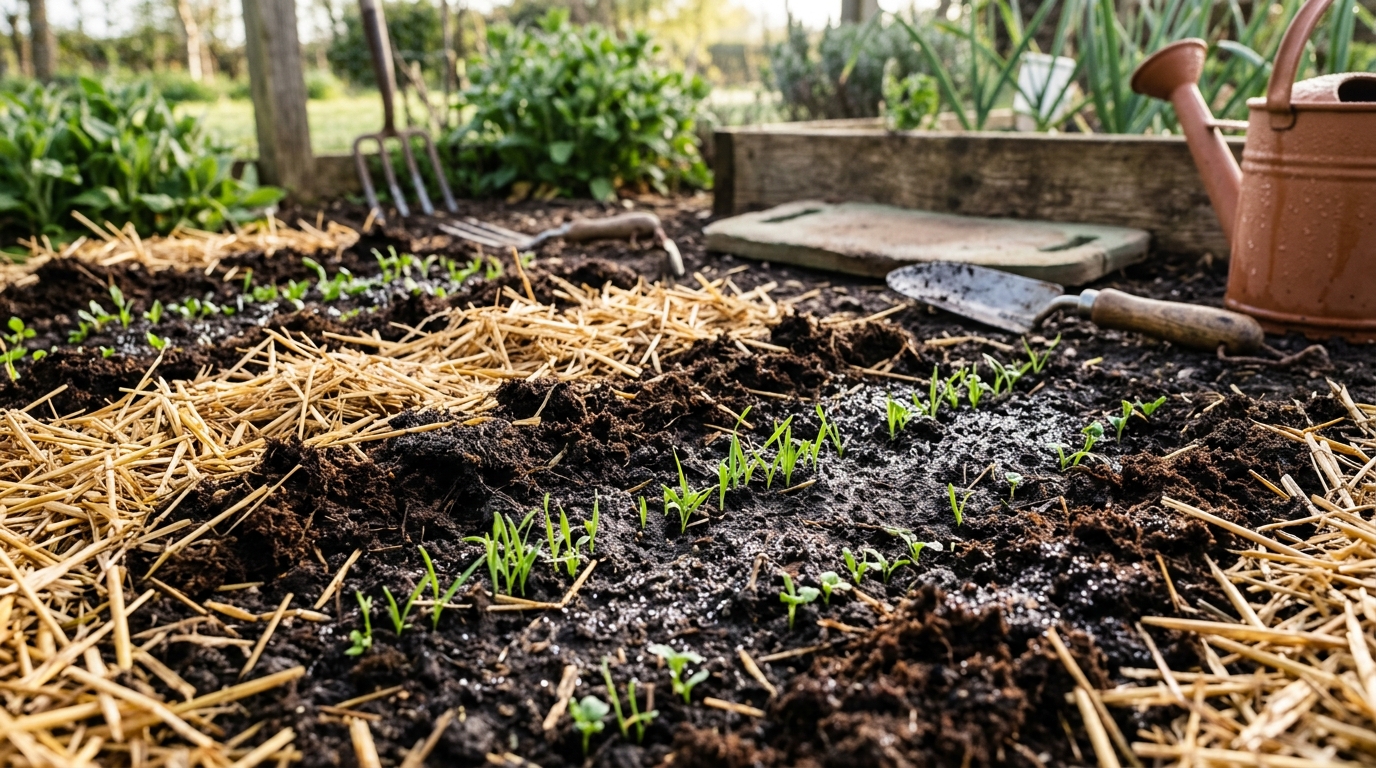
Test your soil pH before seeding. Most grasses thrive between 6.0–7.0 pH. Loosen the top 2–3 inches of soil, remove debris, and add a thin layer of compost for optimal seed-to-soil contact.

02

Perfect Timing

Cool-season grasses (Fescue, Bluegrass, Ryegrass) establish best in early fall when soil temps are 50–65°F. Warm-season varieties (Bermuda, Zoysia) prefer late spring when soil reaches 65–70°F.

03

Watering Strategy

Keep newly seeded areas consistently moist — not soaked. Water lightly 2–3 times daily for the first two weeks, then transition to deeper, less frequent watering as roots establish.

04

Even Distribution

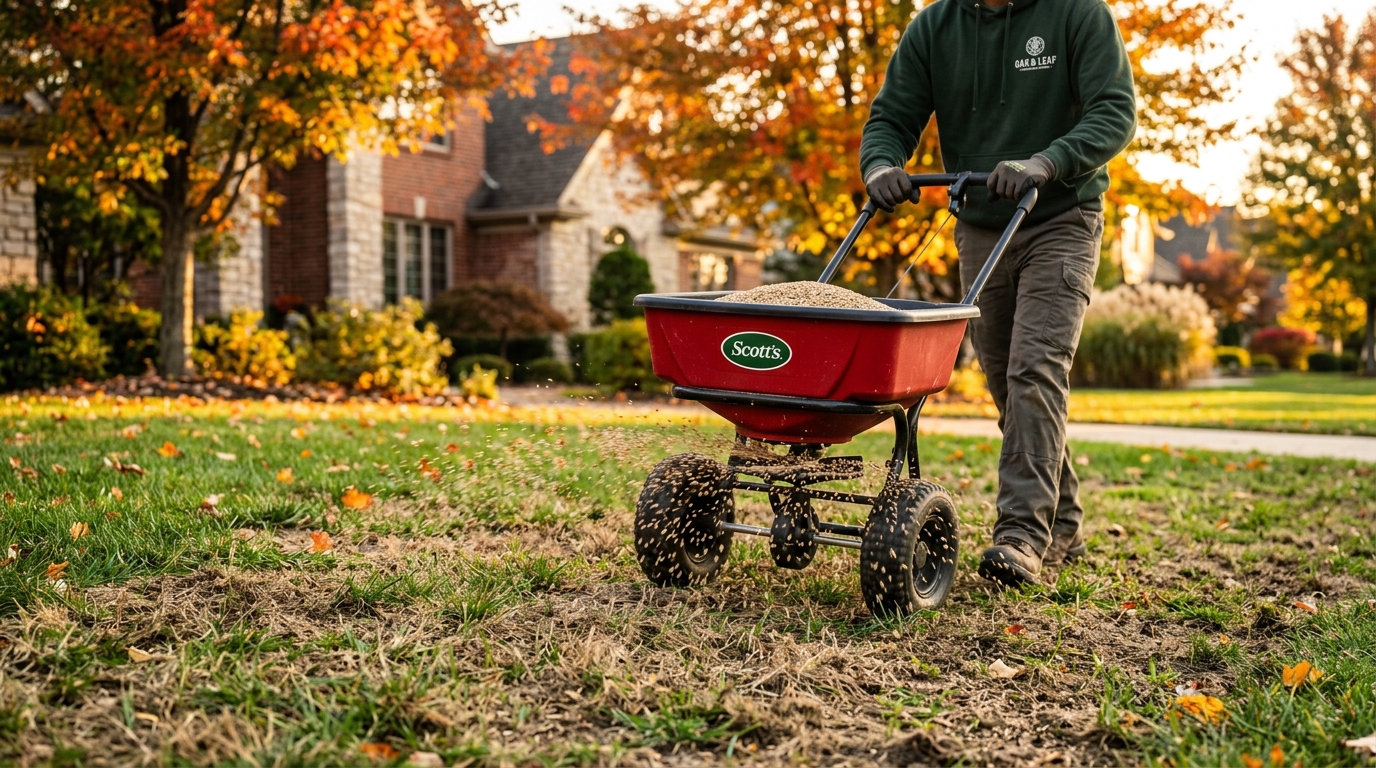
Use a broadcast spreader for large areas and apply seed in two passes — one north-south and one east-west. This cross-hatch pattern ensures uniform coverage and prevents bare patches.

05

First Mow

Wait until new grass reaches at least 3–4 inches before the first mow. Never cut more than one-third of the blade height in a single mowing. Use a sharp blade to prevent tearing seedlings.

06

Starter Fertilizer

Apply a phosphorus-rich starter fertilizer at seeding time to promote root development. Avoid high-nitrogen fertilizers until the lawn is established — they can burn tender seedlings.

07

Spreader Selection

Use a broadcast spreader for areas over 1,000 sq ft (92.9 m²) and a drop spreader for precise edges. Set the spreader dial to match your grass seed’s recommended rate — check the label for spreader settings. Scotts and Pennington seed bags list settings for most popular spreader models.

Frequently Asked Questions

How much grass seed do I need per 1,000 square feet?

It depends on the grass type. Tall Fescue requires 8–10 lbs per 1,000 sq ft, while Kentucky Bluegrass needs only 2–5 lbs. Bermuda Grass falls in between at 3–4 lbs. Use our calculator above for precise amounts based on your specific lawn dimensions.

What is the difference between seeding a new lawn vs. overseeding?

Overseeding means spreading seed over an existing lawn to fill in thin areas and improve density. It requires roughly 50% of the seed rate compared to establishing a new lawn from bare soil, since you already have grass covering part of the area.

Can I mix different grass seed types together?

Yes, blending compatible grass types is common and often recommended. For example, mixing Kentucky Bluegrass with Perennial Ryegrass creates a resilient lawn — the ryegrass germinates quickly while the bluegrass fills in over time. Stick to grasses within the same season type (cool-season with cool-season).

When is the best time of year to plant grass seed?

For cool-season grasses, early fall (late August through September) is ideal. The soil is still warm enough for germination, but cooler air temps reduce heat stress. Warm-season grasses should be planted in late spring to early summer when soil temperatures consistently reach 65°F or higher.

How do I calculate area for non-rectangular lawns?

Our calculator supports four lawn shapes: Rectangle, Circle, Triangle, and Ellipse. For irregular lawns, break them into simpler shapes, calculate each separately, and add the results. For circles, just enter the radius. For triangles, enter the base and height.

Should I buy extra seed beyond what the calculator recommends?

Yes. Our calculator includes a buffer slider (default 10%) to account for seed lost to wind, uneven spreading, birds, and areas that may need touch-up reseeding. You can adjust this from 0% to 30% based on your confidence in your spreading technique.

Does this calculator support metric measurements?

Yes. Each dimension field has its own unit selector supporting centimeters, meters, kilometers, inches, feet, yards, miles, and compound units. All calculations automatically convert between systems, and results are displayed in both pounds and kilograms.

How much grass seed do I need for 1 acre?

One acre equals 43,560 square feet (4,046.86 m²). At a typical coverage rate of 4 lbs per 1,000 sq ft, one acre needs about 174 lbs (79 kg) of grass seed for a new lawn or 87 lbs (39.5 kg) for overseeding. Tall Fescue at 9 lbs per 1,000 sq ft requires about 392 lbs (178 kg) per acre. Enter your exact dimensions in the grass seed calculator above for a precise estimate.

What is a coverage rate (CR) for grass seed?

The coverage rate (CR) is the amount of seed needed per unit of area, such as pounds per 1,000 square feet or kilograms per 100 square meters. Coverage rates differ between grass types and between new lawn seeding and overseeding. This value is printed on seed bag labels from brands like Scotts, Pennington, and Jonathan Green. The grass seed calculator auto-fills the coverage rate when you select a grass type, but you can override the value manually.

How long does grass seed take to germinate?

Germination time ranges from 5 days to 30 days depending on grass type. Perennial Ryegrass germinates fastest at 5–10 days. Tall Fescue and Fine Fescue take 7–14 days. Kentucky Bluegrass is slowest among cool-season grasses at 14–30 days. Warm-season grasses like Bermuda (10–30 days), Zoysia (14–21 days), and Centipede (14–28 days) need warm soil temperatures above 65°F (18°C) for germination to start. Consistent moisture, direct sun exposure, and proper soil preparation all shorten germination time.

What is the best grass seed for shade?

Fine Fescue is the best grass seed for deep shade, with a seeding rate of 4–6 lbs per 1,000 sq ft (1.95–2.93 kg per 100 m²). Tall Fescue tolerates moderate shade and handles foot traffic better. For warm-season lawns in southern climate zones, Zoysia Grass handles partial shade better than Bermuda. St. Augustine is shade tolerant but grows from sod or plugs, not seed.

How do I calculate grass seed for overseeding?

Use 50% of the new-lawn seeding rate when overseeding. Tall Fescue at 8–10 lbs per 1,000 sq ft for a new lawn becomes 4–5 lbs per 1,000 sq ft (1.95–2.44 kg per 100 m²) for overseeding. Kentucky Bluegrass drops from 2–5 lbs to 1–2.5 lbs per 1,000 sq ft. The grass seed calculator handles this automatically — select “Overseeding” in the Project Type toggle, and the seed output adjusts to 50% of the full rate.

This grass seed calculator estimates the exact amount of grass seed you need based on your lawn’s shape, area, and your chosen seed’s coverage rate (CR). Whether you need a grass seed amount calculator for a small patio lawn or a grass seed area calculator for a large property, enter dimensions in square feet (ft²), square meters (m²), or acres and get instant seed quantities in pounds (lbs) or kilograms (kg). Use this calculator for grass seed to plan new lawn seeding, overseeding, or patch repair across 10 grass types, including Kentucky Bluegrass, Tall Fescue, Bermuda Grass, and Perennial Ryegrass. The tool also serves as a grass seed coverage calculator — it tells you exactly how much area your grass seed will cover at any application rate.

How to Use the Grass Seed Calculator

How do you know how much grass seed to put down? Follow these 4 steps to calculate the exact grass seed quantity for your lawn:

  1. Choose your grass type from the dropdown. The grass seed calculator auto-fills the coverage rate (CR) based on your selection. Supported grass types include Bermuda Grass, Tall Fescue, Fine Fescue, Kentucky Bluegrass, Perennial Ryegrass, Zoysia, Centipede, Bahia, Buffalo, and St. Augustine.
  2. Select your lawn shape and enter dimensions:
    • For a rectangular lawn, enter width and length.
    • For a circular lawn, enter the radius.
    • For an elliptical lawn, enter axis A (semi-major) and axis B (semi-minor).
    • For a triangular lawn, enter the base and height.
    Each dimension field has its own unit selector — switch between feet, meters, yards, inches, centimeters, kilometers, or miles.
  3. Set your project type. Choose “New Lawn” for bare soil, “Overseeding” for existing turf (50% seed rate), or “Patch Repair” (75% seed rate).
  4. Adjust the buffer slider from 0% to 30% to account for seed lost to wind, birds, and uneven spreading. The default is 10%.

The results panel displays the estimated amount of seeds in pounds and kilograms, lawn area in square feet and square meters, estimated bag count, and total cost (enter a bag price to enable cost estimation). This grass seed estimator answers the core question: how much grass seed do you spread on your specific lawn dimensions?

1
Grass Type
2
Shape & Size
3
Project Type
4
Results

Select a grass type from 10 varieties. The coverage rate auto-fills based on your selection.

Grass Seed Calculator by Square Feet, Acre & Square Meter

The grass seed calculator computes your lawn area automatically based on the shape and dimensions you enter. The area calculation formula changes by shape:

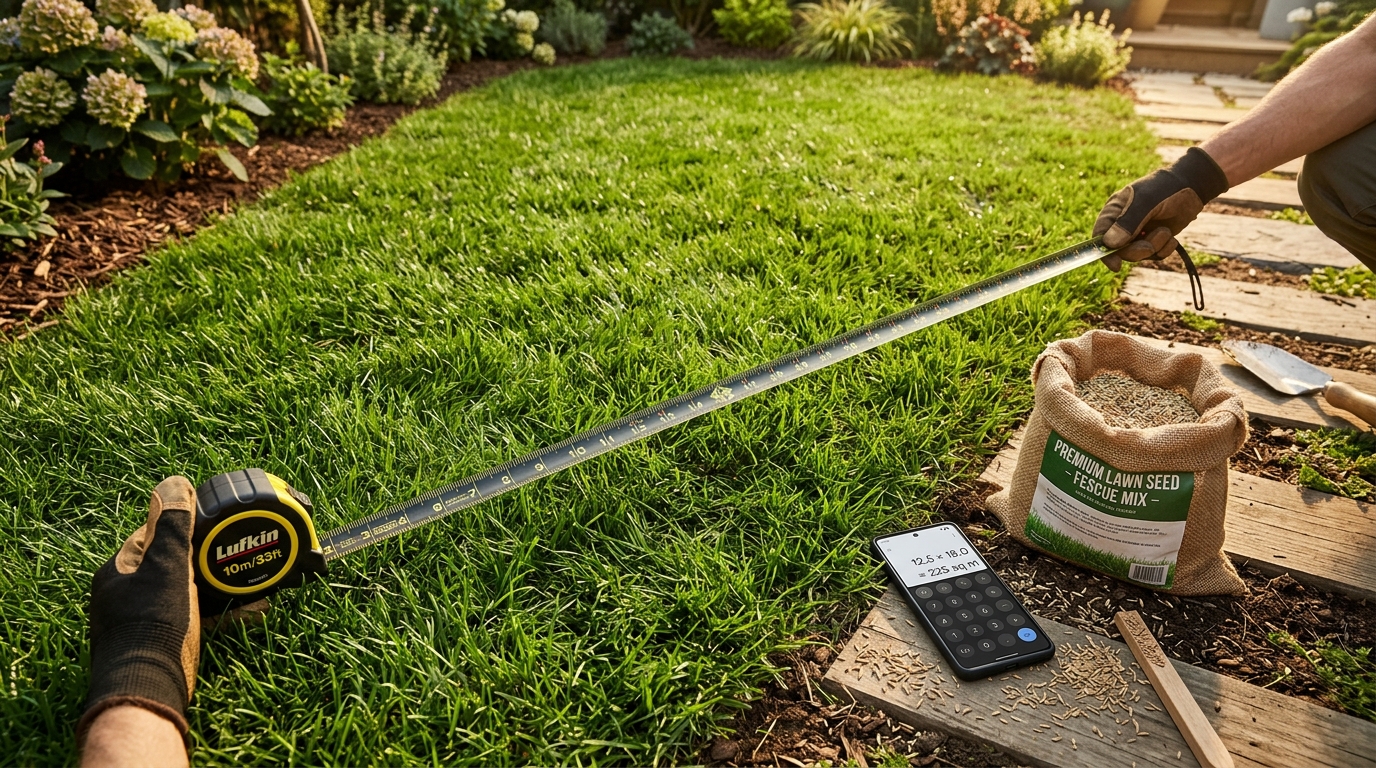
  • Rectangle area = width × length
  • Circle area = π × radius²
  • Ellipse area = π × axis A × axis B
  • Triangle area = ½ × base × height

Common area conversions the calculator handles:

  • 1 acre = 43,560 square feet (ft²) = 4,046.86 square meters (m²)
  • 1 square meter = 10.764 square feet
  • 1 hectare = 2.471 acres = 10,000 m²
Example: A rectangular lawn 100 feet (30.48 m) wide and 150 feet (45.72 m) long has an area of 15,000 ft² (1,393.5 m²), or about 0.34 acres.

You can mix units across fields — enter width in feet and length in meters, and the grass seed calculator converts everything internally before computing the area. This makes the tool equally useful as a grass seed per square foot calculator, a grass seed calculator per acre for large properties, or a grass seed per m2 calculator for metric users.

width length Rectangle w × l
r Circle πr²
A B Ellipse π × A × B
base h Triangle ½ × b × h

How Much Grass Seed Do You Need? (Coverage Guide)

The amount of grass seed you need equals your lawn area multiplied by the seed’s coverage rate (CR). Knowing how to calculate grass seed coverage is essential for any seeding project — too little seed leaves bare patches, and too much causes overcrowding that weakens turf.

seeds (lbs) = coverage rate (lbs / 1,000 ft²) × area (ft²) ÷ 1,000
Example: A 5,000 ft² (464.5 m²) lawn planted with Kentucky Bluegrass at a coverage rate of 3.5 lbs per 1,000 ft² needs:
3.5 × 5,000 ÷ 1,000 = 17.5 lbs (7.94 kg) of seed
Add a 10% buffer for waste: 17.5 × 1.10 = 19.25 lbs (8.73 kg) total.

Coverage rates are printed on every seed bag from brands like Scotts, Pennington, and Jonathan Green. The grass seed calculator auto-fills the rate when you select a grass type, but you can override the value manually. How much area does grass seed cover? That depends entirely on the variety — a single pound of Kentucky Bluegrass covers roughly 285 square feet (26.5 m²), while a pound of Tall Fescue covers only about 111 square feet (10.3 m²).

3 factors affect how much seed you need:

  1. Grass type — Tall Fescue needs 8–10 lbs per 1,000 ft² (3.90–4.88 kg per 100 m²), while Centipede Grass needs only 1–2 lbs per 1,000 ft² (0.49–0.98 kg per 100 m²).
  2. Project type — Overseeding uses 50% of the new-lawn rate because existing grass already covers part of the area.
  3. Soil and sun conditions — Shaded areas and sandy soils may need a higher application rate to achieve full coverage.
Quick Seed Estimator
5,000 ft²
17.5 lbs
7.94 kg
0 lbs 50 lbs

New Lawn vs. Overseeding — Seeding Rates Explained

New lawn seeding requires the full coverage rate; overseeding requires 50% of that rate.

A new lawn starts from bare soil. Every square foot (0.093 m²) needs full seed coverage because no existing grass is present. Use the new grass seed calculator setting (“New Lawn”) to apply the full coverage rate. Overseeding spreads seed over an established lawn to fill thin spots, improve density, and introduce stronger grass varieties. The existing turf already covers part of the ground, so the seed rate drops by half. Knowing how much grass seed to spread for each project type prevents waste and ensures even germination.

Project Type Rate Multiplier Best Timing
New Lawn 100% of CR Cool-season: early fall • Warm-season: late spring
Overseeding 50% of CR Cool-season: September • Warm-season: May–June
Patch Repair 75% of CR Any time during the growing season
Example: Bermuda Grass has a new-lawn coverage rate of 3–4 lbs per 1,000 ft² (1.46–1.95 kg per 100 m²). Overseeding the same area requires 1.5–2 lbs per 1,000 ft² (0.73–0.98 kg per 100 m²).

Prepare bare soil before seeding a new lawn — loosen the top 2–3 inches (5–7.5 cm), remove debris, and test soil pH. Most grass types germinate best in soil with a pH between 6.0 and 7.0. For overseeding, mow the existing lawn short and rake to expose soil before spreading seed.

Seed Rate Comparison
New Lawn 100% of CR
Full seeding rate • Bare soil
Patch Repair 75% of CR
Spot treatment • During growing season
Overseeding 50% of CR
Over existing turf • Fall or spring

Grass Seed Coverage by Bag Size (20 kg, 50 lb & More)

The number of seed bags you need equals total seed weight divided by the bag size, rounded up.

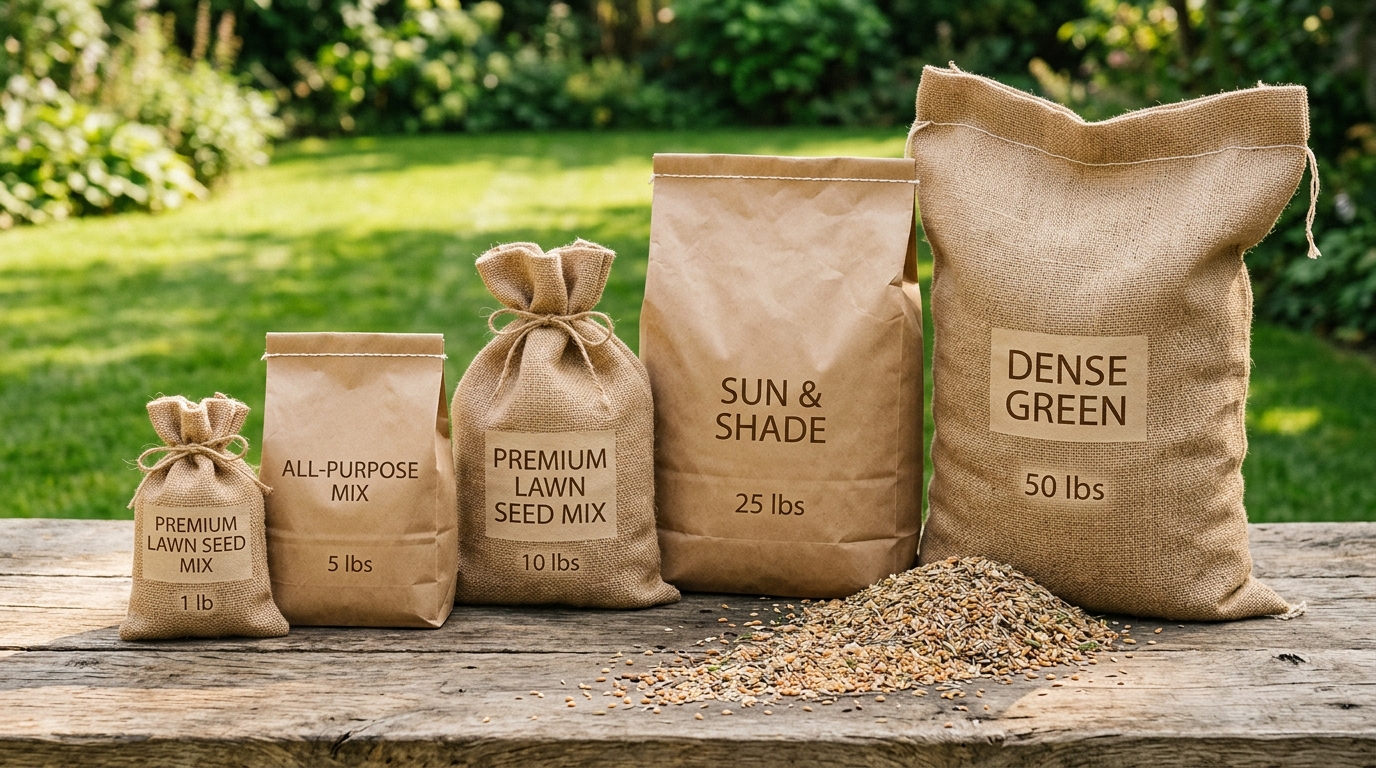
Grass seed is sold in standard bag sizes. Here is how far each bag covers at a typical rate of 4 lbs per 1,000 ft² (1.95 kg per 100 m²):

Bag Size Coverage (New Lawn) Coverage (Overseeding)
5 lbs (2.27 kg) 1,250 ft² (116 m²) 2,500 ft² (232 m²)
10 lbs (4.54 kg) 2,500 ft² (232 m²) 5,000 ft² (464 m²)
25 lbs (11.34 kg) 6,250 ft² (581 m²) 12,500 ft² (1,161 m²)
50 lbs (22.68 kg) 12,500 ft² (1,161 m²) 25,000 ft² (2,323 m²)
20 kg (44.09 lbs) 11,023 ft² (1,024 m²) 22,046 ft² (2,048 m²)
Example: A 10,000 ft² (929 m²) new lawn with Tall Fescue at 9 lbs per 1,000 ft² needs 90 lbs (40.82 kg) of seed — that is 4 bags of 25 lbs or 2 bags of 50 lbs.

Enter a bag price in the calculator’s cost estimator to see total estimated spend. Buying larger bags reduces cost per pound in most cases. How much grass seed per square foot do you need? Divide your coverage rate by 1,000 — at 4 lbs per 1,000 ft², that is 0.004 lbs (1.8 g) per square foot.

Tap a bag to see coverage
5
5 lbs
10
10 lbs
25
25 lbs
50
50 lbs
New Lawn Coverage 1,250 ft²
Overseeding Coverage 2,500 ft²
1 of 8 sections (1,250 ft² each)

Seeding Rates by Grass Type

Seeding rates range from 1 lb per 1,000 ft² (0.49 kg per 100 m²) for low-density warm-season grasses to 10 lbs per 1,000 ft² (4.88 kg per 100 m²) for dense cool-season bunch grasses.

Cool-Season Grasses

  • Kentucky Bluegrass — 2–5 lbs per 1,000 ft² (0.98–2.44 kg per 100 m²). Germination takes 14–30 days. Kentucky Bluegrass spreads through rhizomes and self-repairs bare spots over time. Best for premium lawns in USDA zones 3–7.
  • Tall Fescue — 8–10 lbs per 1,000 ft² (3.90–4.88 kg per 100 m²). Germination: 7–14 days. Tall Fescue is a bunch-type grass that tolerates shade and moderate foot traffic. Seed evenly — Tall Fescue does not spread by runners.
  • Fine Fescue — 4–6 lbs per 1,000 ft² (1.95–2.93 kg per 100 m²). Germination: 7–14 days. Fine Fescue performs best in deep shade and low-maintenance settings.
  • Perennial Ryegrass — 7–8 lbs per 1,000 ft² (3.42–3.90 kg per 100 m²). Germination: 5–10 days. Perennial Ryegrass germinates faster than any other cool-season grass and is ideal for overseeding blends and erosion control.

Warm-Season Grasses

  • Bermuda Grass — 3–4 lbs per 1,000 ft² (1.46–1.95 kg per 100 m²). Germination: 10–30 days. Bermuda Grass thrives in full sun and handles heavy traffic. Plant when soil temperature reaches 65°F (18°C) or higher.
  • Zoysia Grass — 1–3 lbs per 1,000 ft² (0.49–1.46 kg per 100 m²). Germination: 14–21 days. Zoysia Grass forms an extremely dense turf once established but has a long grow-in period.
  • Centipede Grass — 1–2 lbs per 1,000 ft² (0.49–0.98 kg per 100 m²). Germination: 14–28 days. Centipede Grass prefers acidic soil (pH 5.0–6.0) and needs less fertilizer than most grass types.
  • Bahia Grass — 7–10 lbs per 1,000 ft² (3.42–4.88 kg per 100 m²). Germination: 14–28 days. Bahia Grass develops deep roots and handles drought and sandy soils well.
  • Buffalo Grass — 3–5 lbs per 1,000 ft² (1.46–2.44 kg per 100 m²). Germination: 14–30 days. Buffalo Grass is a native prairie species that needs minimal irrigation once established.

St. Augustine Grass is not available as seed. Establish St. Augustine lawns through sod or plugs.

How much grass seed per acre do you need? Multiply the per-1,000 ft² rate by 43.56. For example, Kentucky Bluegrass at 3.5 lbs per 1,000 ft² requires about 152 lbs per acre. Select your grass type in the grass seed calculator above to auto-fill the correct coverage rate and get an instant seed estimate for your lawn area.

Seeding Rate Comparison (lbs per 1,000 ft²)
Tall Fescue
8–10
Bahia Grass
7–10
Perennial Ryegrass
7–8
Fine Fescue
4–6
Buffalo Grass
3–5
Kentucky Bluegrass
2–5
Bermuda Grass
3–4
Zoysia Grass
1–3
Centipede Grass
1–2
Cool-Season Warm-Season